

Chat, Voice, Operator
How Littleton, CO, Took the Guess Work Out of Resident Needs, Cutting Calls by 50%


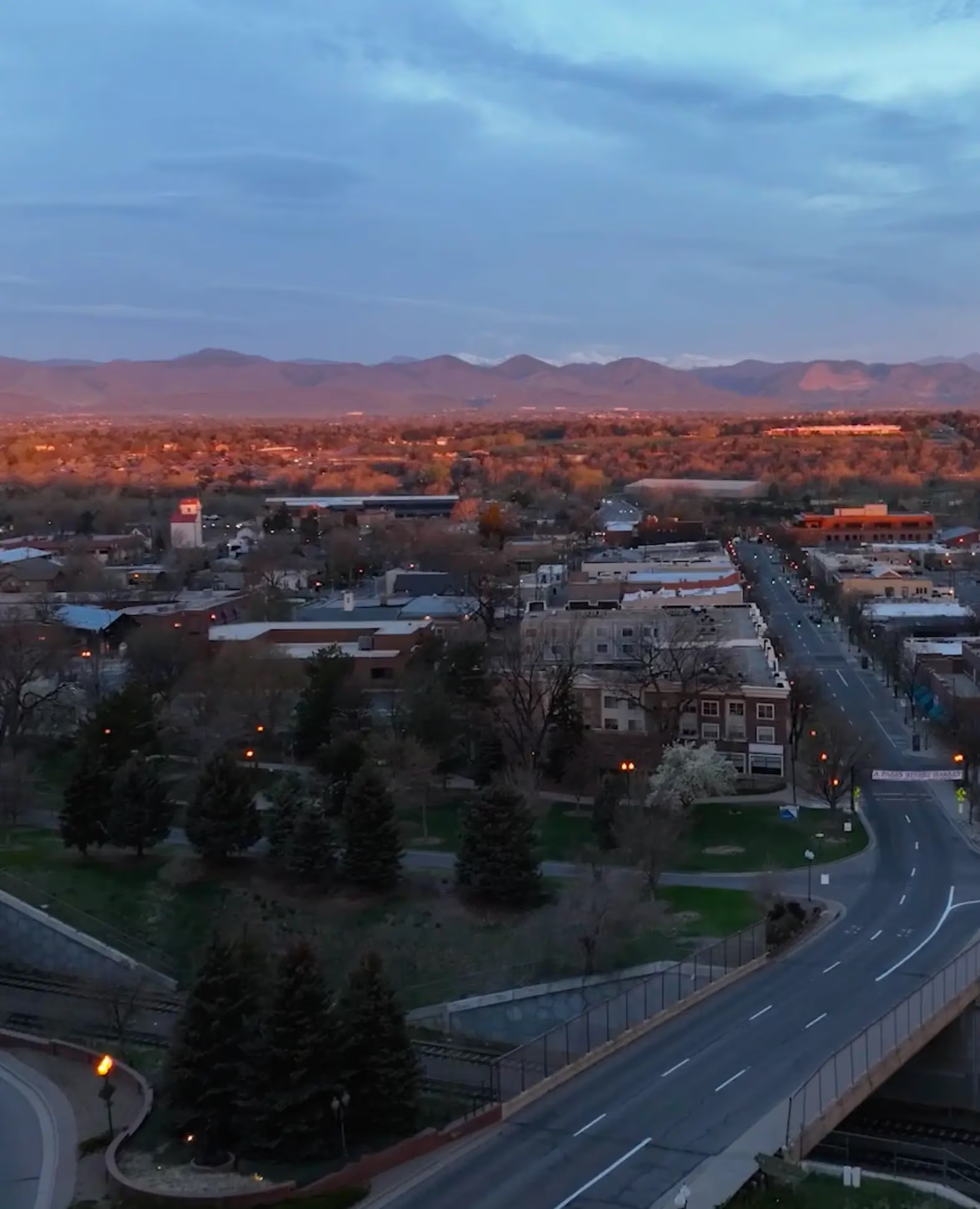
Like many cities, Littleton, Colorado operates as a lean organization where staff often wear multiple hats. "We sort of have a jack-of-all-trades work culture," says CIO Scott Rogers. "Most of us are working managers or our employees are doing multiple duties throughout the day."
In a "jack-of-all-trades" team environment, efficiency isn't a luxury; it is a necessity.
"Figuring out how to have a multiplier effect on each employees' time is something that we're always searching for," says Deputy City Manager Mike Gent. "We want to free them up for higher, better use of their time."
The City knew AI would unlock opportunities, but as budget-conscious stewards of public funds, they needed a strong business case before moving forward with anything.
"We don't have a library of developers to become a code shop," explains Rogers. "We needed a commercial off-the-shelf AI solution that we could configure for our needs, not code."
Return on Investment
50% Reduction in Calls
Freeing time for reception staff to be more present and productive.
Newfound Visibility
Replaced "dry" quantitative logs with a single pane of glass that reveals exactly why residents are reaching out, surfacing trends and ideas for improvement.
24/7 Service Continuity
Residents now get answers and direct transfers for permits and police non-emergencies on nights and weekends, and staff begin their day with fewer voicemails.
Seamless Rollout
The City proved the technology internally first, building consensus across departments and launching without a risky "big bang" overhaul or heavy change management.
Challenge
The Search Failure:
The City’s search function came standard with their website, but it was keyword-based and rigid. "It would get fixated on one result or just provide a number of results that really didn't follow what the person was searching for," explains Rogers. "It was really just word based rather than phrase, intent, or question based."
This forced staff to manually "manufacture" improved results on the backend just to get the right pages to rank more often. When residents couldn't find answers online, they picked up the phone.
The "Switchboard" Trap:
Unfortunately for those who weren’t helped by the website, the City's phone tree was broken by simple math. "We have 13 different departments, but only 10 buttons on a keypad," explains CIO Scott Rogers.
This forced the City to bury services inside a deep menu structure. "To really get to any level of detail, you would have to go two or three menus down," Rogers notes. “If you didn't know exactly who handled your issue, you’d end up going down the wrong route. Residents would get lost, try to navigate back, and eventually just give up."
As a result, residents would reach the wrong department and need to be transferred while others developed a habit of pressing "0" to bypass the system entirely. This flooded the receptionist who was already responsible for welcoming guests, fielding walk-in questions, and managing mail, badging, and security. Competing demands often pulled her away from the phone.
"Finding ways to 'do more with less' is not really an option," says Gent. "We can't sustainably just keep adding to their lists. We had to figure out how to help our teams do less of what is not productive."
The Visibility Gap:
Despite the high volume of calls and searches, the City didn't know where to focus their attention. CIO Scott Rogers describes the old system as a "black box." The City had data, but it was dry, quantitative, and sourced from disparate systems. They had logs showing which number called whom and for how long, but they missed the context of why they called or where the friction was. Without those insights, the City couldn't surface trends or bridge the gap between resident questions and City answers.
Solution
Building Confidence Through a Measured Rollout
Littleton knew that AI was inevitable, yet they didn't need a risky tech overhaul. They needed a partner who could prove value incrementally. The City chose Polimorphic voice and chat, co-creating a phased rollout approach to strengthen internal alignment and build community confidence each step of the way.
- Phase 1: Proving it Internally (The Sandbox) Before procurement, Littleton needed to prove that AI could be trusted in a government context. The team used Polimorphic’s sandbox environment to socialize the tool across departments, allowing staff to test the AI against real City data. Their "prove-it" phase was critical to building consensus and ensuring the AI would only serve accurate, policy-backed answers. With the confidence and consensus that comes from first-hand experimentation, ownership and approval followed across the organization which supported the procurement, implementation and rollout process.
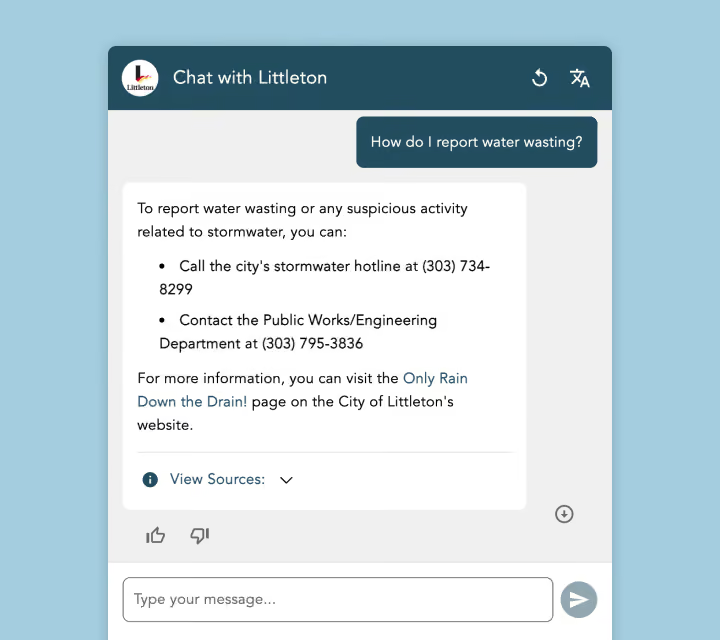
- Phase 2: The Chatbot (A Better Option) Littleton’s existing website search was struggling to connect residents with the right information. Rather than ripping out the search bar immediately, the City simply offered Polimorphic as a better alternative. Launched in Fall 2025, the chatbot quickly became the preferred tool for both residents and staff. In just a few months, it handled over 1,500 inquiries proving that people will choose the path of least resistance when it works.
- Phase 3: The Voice Multiplier With the AI's accuracy proven with Chat, the City extended the platform to their main phone line to address over 1,000 calls each month. Their AI Voice operator now serves as the "front door" to the City by answering routine questions 24/7 and routing complex requests to the right department.
The Results
Turning the Lights On
By applying AI to real service problems, Littleton rapidly unlocked capacity from their existing teams and is continuously improving operations as trends surface.
- Stewardship of Staff Time: Call volume to the receptionist dropped by ~50%, freeing staff to focus on badging, security, and visitor experience instead of acting as a switchboard. "The cost was really easy to justify in hindsight in how it's saving us time," said Gent. "It helps us more accurately and effectively get people to where they want to go."
- Data-Backed Insights: The City replaced "dry" quantitative logs with a single pane of glass that reveals exactly why residents are calling or what they are searching for on the web. "We have visibility that we never had before," said Rogers. "We can see exactly how often a particular question is asked and the path that gets us to the answer."
- Service Continuity: Residents now get answers and direct transfers for permits and police non-emergencies on nights and weekends, instead of hitting a voicemail dead end.
- Force Multiplier: By offloading over 1,000 routine calls to AI each month, the City unlocked capacity for its lean team to focus on high-value work.
What's Next
From Reactive to Proactive
Littleton has proven that governments don't need to replace tech to improve service; they just need to remove the friction that slows them down. In 2026, the team plans to enable Polimorphic search on their website, and improve the phone experience with further integrations and GIS-powered answers.
By capturing every interaction from a resident’s first question to the final resolution, Littleton has moved from a reactive posture to a proactive one. They are no longer guessing what residents need; they have the data to prove it.
"Polimorphic allows us to focus on the results we drive to our citizens, not the development of the tool or management of the code," says Rogers. "We never want to eliminate the human from the equation, but Polimorphic’s platform allows them to be more present and work on higher-level things with higher quality outputs which helps every other team."
As the City moves forward, they are building a "new normal" where service is continuous, insights are automatic, and staff are free to focus on the work that matters most.

Want a copy of this case study?
We'll email you a PDF you can save or share.
Read more stories like this

CRM & Workflows
How Polk County, North Carolina, Leveraged Polimorphic to Streamline Disaster Response
When Hurricane Helene swept through North Carolina, it caused more than 100 fatalities and damaged over 73,000 homes. For Polk, a close-knit community known for its scenic beauty, this was the biggest disaster it had experienced. After storm recovery, priorities turned to damage assessments. Polk County needed an innovative solution that addressed these challenges efficiently and quickly.


CRM & Workflows
Tooele County, Utah Recorders Department Increases Document Processing Capacity, Customer Service, and Data Accuracy
In recent years, the Tooele County Recorder's Office faced a dramatic increase in document volume, tripling the amount of work while maintaining the same staff size. The complexity of the documents being processed also grew, with more subdivisions and development projects adding to the workload.


POLIMORPHIC IN ACTION
