


The Freedom of Information Act (FOIA) allows citizens to request information from federal government agencies. It was introduced in 1966 to hold public officials accountable and ensure transparency with data.
In addition to a federal mandate for transparency, the same laws exist in individual states. As of late, however, the offices that answer those requests are feeling the squeeze. Volumes are up, the records themselves are messier, and staff numbers haven't grown to match.
Let’s dive a bit deeper into what these requests are called across the country and why the number of requests keep rising.
"FOIA" is shorthand most people recognize, but every state has its own statute covering state and local government, and each one has its own name, its own deadlines, and its own exemptions. If you've ever filed a request in one state and then tried the same approach in another, you've seen how much the vocabulary shifts.
A sampling of what states call their versions:
The differences go beyond just the naming conventions. Response windows range from a few business days to several weeks, some states allow agencies to charge for search and copying time, and the list of exempt records varies widely. Agencies that serve residents in multiple jurisdictions, or that work with regional partners, quickly learn that "public records" is not one-size-fits-all.
Make sure your staff know the exact statute they're working under, because the clock on a request usually starts the moment it arrives, whatever words the requester used.
The federal data tells a stark story. According to the Department of Justice's annual reporting, federal agencies received more than 1.7 million FOIA requests in fiscal year 2025, roughly 14% more than the year before. Backlogs also grew by about 27%.
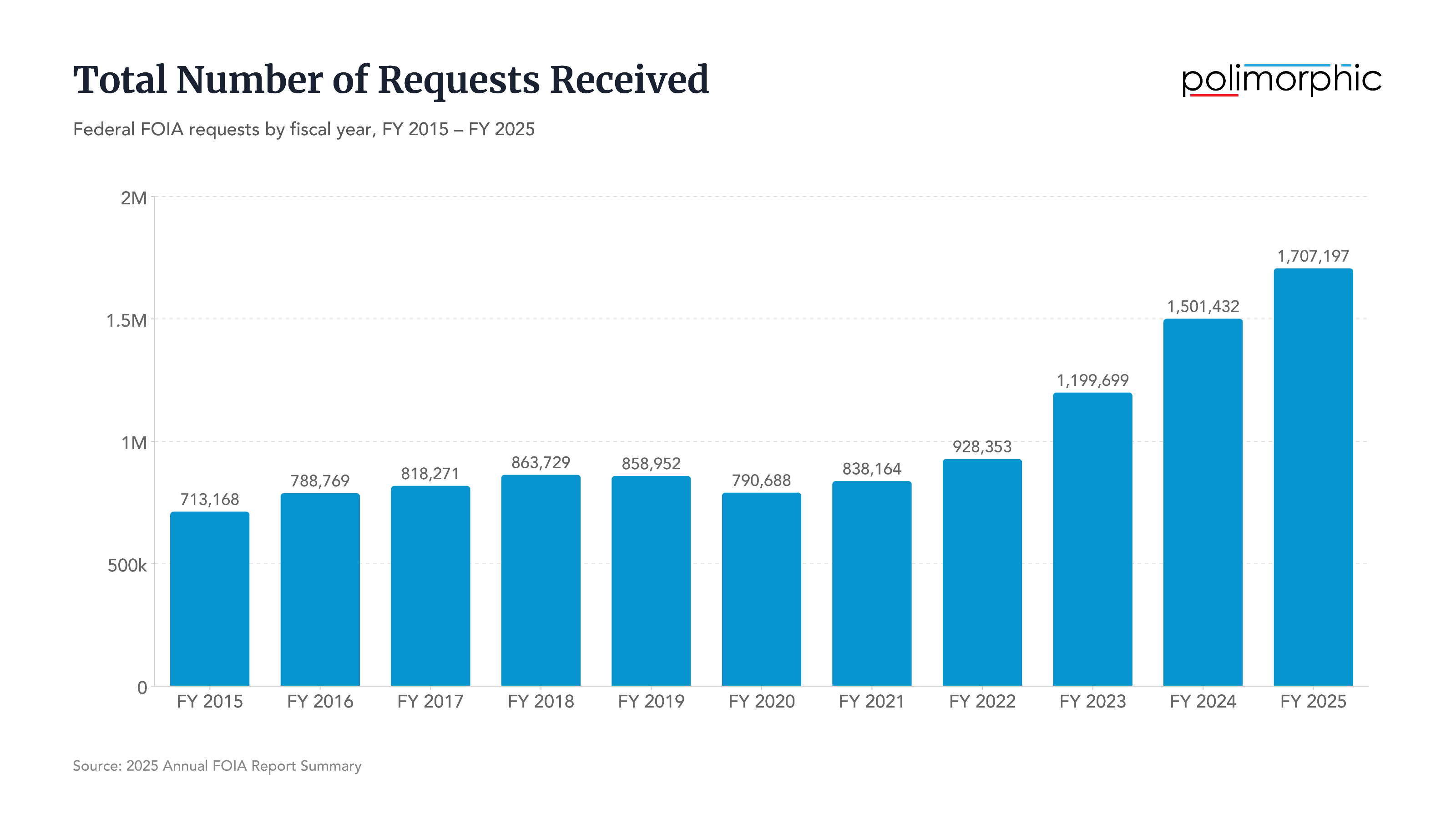
Response times moved the wrong way too. The average time to close a simple request stretched from 44 days to 49. Only about 10% of requests were granted in full, an all-time low. And administrative appeals jumped 59%, a sign that more requesters are challenging answers they consider slow or incomplete.
Local governments are living the same story. In New York City, FOIL requests more than doubled between 2018 and 2024, rising from about 41,000 to over 85,000, and by the end of 2024 well over half of open requests were past due. In San Antonio, the city's open government team grew from two people to twelve in five years, and it handled more than 86,000 requests in 2025 alone.
Several forces are stacking on top of each other, resulting in an increase in information requests.
Government has gone digital, and every digital interaction leaves a trail. Emails, spreadsheets, case files, and databases are only the start. A request that might once have meant pulling a folder from a cabinet now means searching multiple systems, often across several departments.
Body cameras have given law enforcement agencies a new and very popular type of record. Requests for footage are common across many states, and video is expensive to handle because someone has to find it, watch it, redact faces, license plates, and other protected details, and release it securely. The Dayton Police Department, for example, saw video requests climb from about 1,300 in 2023 to more than 3,000 in 2024, and one Ohio police chief has noted that a single video can take up to two hours to edit and redact.
Text messages, social media posts, and workplace chat tools like Slack and Teams can all count as public records when they're used to conduct government business. Many agencies don't have reliable ways to capture, retain, or search them. In Baltimore, two city agencies were found using Slack outside approved systems, and when a news outlet asked for those messages, none were produced until the Inspector General subpoenaed them. Cases like this make requesters more aware that these channels exist, and more likely to ask about them.
Online portals, templates, and public tracking tools have lowered the barrier to filing a request. Residents who handle banking and shopping on their phones increasingly expect the same convenience from their local government, and that expectation applies to records as much as it does to permits or payments.
Journalists, researchers, watchdog groups, and individual residents all rely on public records to understand how decisions get made and how money is spent. When trust in institutions is a live public conversation, records requests tend to follow. A rising appeal rate suggests requesters are also less willing to accept a slow or partial answer and move on.
Rising volume would be manageable if staffing rose with it. Often it doesn't. Many local governments have no dedicated records officer, so requests land on clerks and communications staff who are already stretched. A 2024 Eagle Hill Consulting survey found that 41% of government employees reported burnout, with workload and staff shortages cited as the leading causes.
The consequences compound. Slow responses lead to complaints and appeals and appeals lead to more staff time and sometimes litigation. Residents who wait months for answers may conclude their government is hiding something, when the real culprit is often a manual process that can't keep pace. And when experienced staff burn out and leave, they take hard-won institutional knowledge with them.
There is no quick fix, but a few practices come up again and again among agencies that are coping well:
Whatever your state calls its law, whether that's FOIA, FOIL, CORA, the Open Records Act, or the Right-to-Know Law, the underlying promise is the same—the public has a right to see the records of the people who serve them. Meeting that promise is getting harder, because there are more records, more formats, and more requests than ever. The agencies that fare best will be the ones that treat information requests as a part of their core operations, with the people, processes, and tools to match.
To learn how Polimorphic can help your government agency stay on top of information requests, schedule demo.